WOW, has it really been 3-1/2 months since a blog update??? Our bad!!! We've been posting occasional updates on FaceBook, but apologies for not keeping the blog up to date.
So this will be an abbreviated account of where we've been with some photos and little vignettes of what we've been doing since leaving Cabo Verde earlier this year.
Atlantic crossing:
We had a very good 13-1/2 day crossing from Mindelo to Grenada, at the southern end of the windward islands. The passage was classic tradewinds, with good breeze after motoring south through a large windless hole. After that it was downwind all the way, on a starboard jibe the whole trip!!! Yeah baby!!! Nothing major broke, and we enjoyed the steady breeze taking us to the Caribbean!
And away we go...heading west meant for some beautiful sunsets!
Fishing on this passage was terrible....caught one baby mahi, about the same size as our lure! He was released to grow up a bit! Otherwise, the sargasso weed was so bad that it really limited our fishing time...often we'd be reeling in every couple of minutes to clear the hooks. Yuchhhh...
Total catch report included one plastic bag, one baby mahi, and one blue footed booby, who was happily released unharmed.
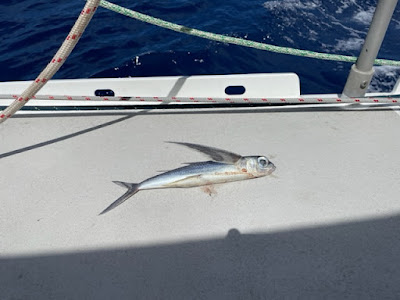 |
| As always, though, the morning deck walk found a few flying fish and squid suicides. |
We finally arrived in Grenada at 1 am, in a 30 knot driving rainstorm. Ughhhhh!
A quick anchor rum, and it was off to a nice deep sleep!!!
Grenada:
Grenada proved to be an excellent landfall to get our proverbial Caribbean feet wet. Much like Pacific Mexico, we called it "cruising light"! Everything needed was easily available. The morning cruisers net, much like the "spit and shit" gatherings in La Paz, had local announcements about goings on around the island, everything from where to get your propane filled, to HASH runs, to technical boat repairs. It proved to be our home for several weeks....perhaps too long, as it meant we've been a bit cramped for time as we got into the more northern islands.
We were happy to meet up with some cruising friends here, including fellow Boreal Positive Waves, who we hadn't seen since France, as well as mates on Offspring and Ruffian. But most folks on boats here are snowbirds, living aboard in the winters, and flying back up to homes in the US, Canada, or Europe for the summers. Relatively few full time cruisers here, compared, say, to the South Pacific islands. But the rum drinks are cold, the trade winds blow, and the locals couldn't be friendlier.....in a word, it doesn't suck!!!
We enjoyed a few of the weekly HASH run/walks, put on by the local chapter of the Hash House Harriers, an international running club with the motto "a club for drinkers with a running problem"!!! The events were a great way to get some exercise while meeting a fun gang of locals, cruisers, and expats living full time in Grenada.
Afterwards there's a big feed of "oil down", a local stew of breadfruit, pork, curry and greens, and obviously plenty of Carib beer to wash it all down. A fun way to spend a Saturday afternoon!
And speaking of oil.....check out this guy who we passed one day on the road...he was practicing for upcoming carnival season. A Grenadan tradition, "jab jab" is a celebration of the local people's release from slavery, where they had been brought from Africa to work the sugar cane plantations. It involves ladling gallons of old motor oil over head, while trailing the ropes of bondage. Dramatic, and not advised for the timid!!!
We enjoyed a great tour of the island, led by guide Cutty. There's a lot to see, especially up in the north end.
 |
| Cutty was an encyclopedia of the local plants and animals |
 |
| Cindi agreed to take one for the team, and soon attracted a throng of not-so-brave tourists! |
 |
| Cocoa beans drying in the sun. Grenada is a major producer. |
 |
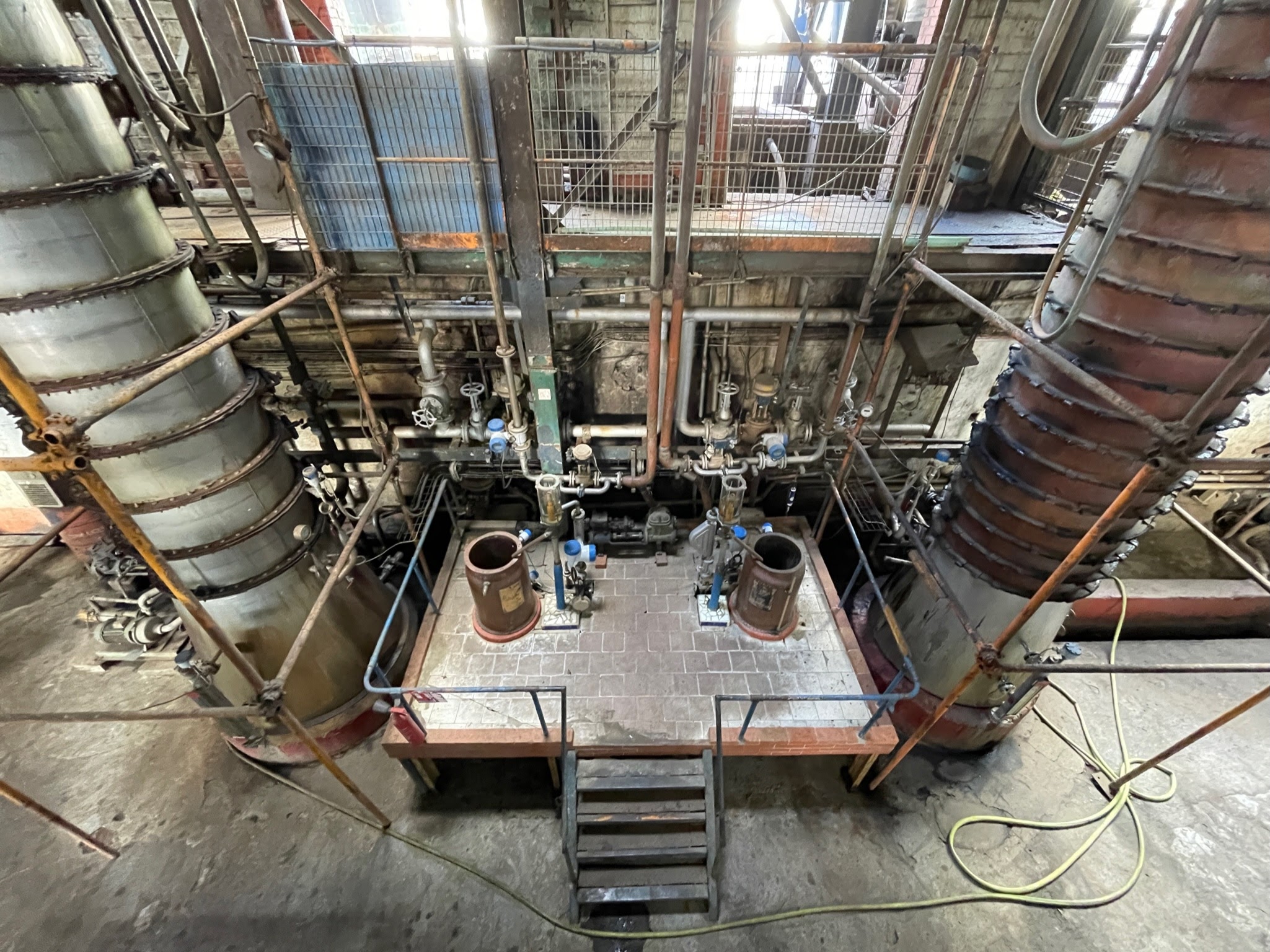
| And of course, of rum as well, seen here in the primary fermentation tanks. |
Grenada proved a good place for us to get some work done on Bravo. All of the major marine trades and vendors are available here. We needed a bit of sail repair done to a couple of chafed spots after the passage.
Also, we had noticed that our genset seemed to wobble too much from side to side as we rolled in the swells on the open ocean. There is a Northern Lights (our genset's manufacturer) dealer on the island, and they came out to check it out. Found that the mounts had been installed upside down!!! Happily no long term damage done, and it just took a couple of hours to get it corrected.
And finally, a few parting shots of Grenada.....
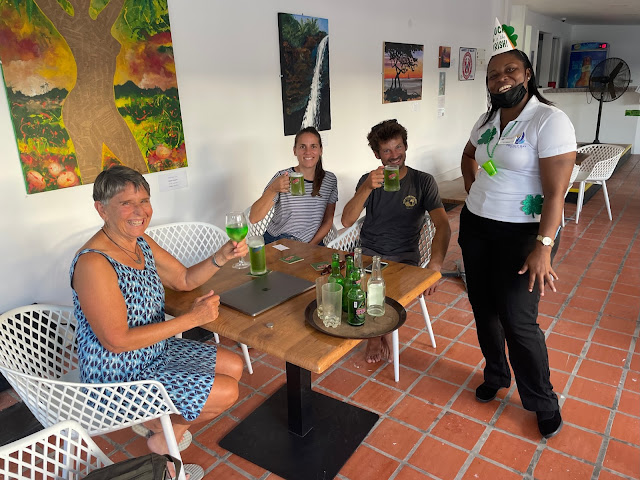 |
| St. Patrick's day, complete with green beer and wine, with Jesse and Lynn from sy Offspring |
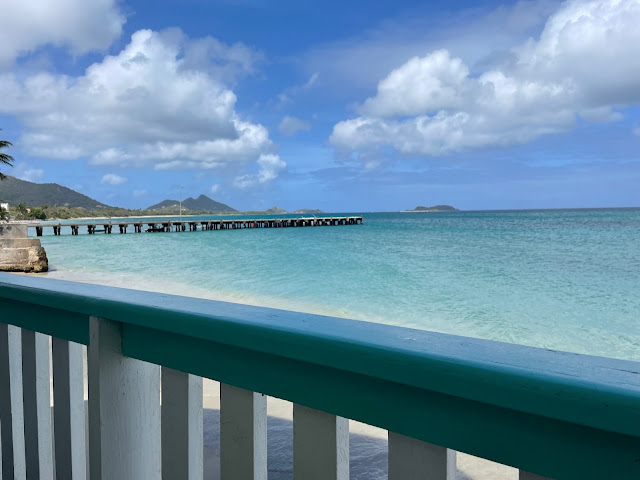 |
| Island of Cariacou, part of Grenada, was one of our favorite spots! |
St. Lucia:
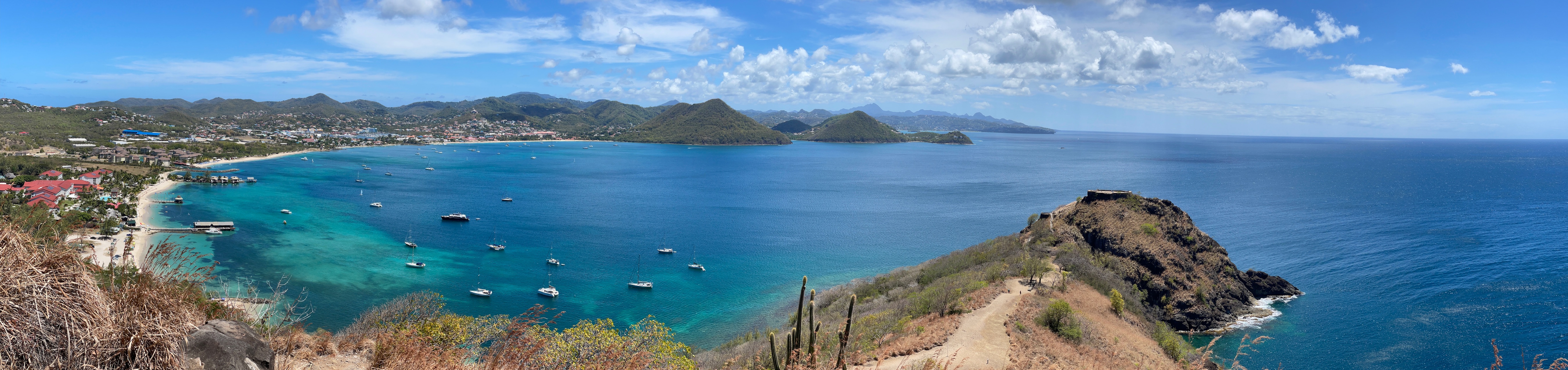
After all of the time spent in the "Spice Islands" of Grenada, it was time to get up to St. Lucia, where friends Paul and Melissa were flying in from Seattle for a couple of week holiday, spent both on shore and with us aboard Bravo. Amazingly, we were also able to rendezvous for a few hours with old Seattle friends Paul and Mary, who coincidentally were sailing on a cruise clipper ship, and were anchored in Marigot bay for a morning. Fun!
Our time in St. Lucia was brief, but very nice. We spent our time here in both Marigot Bay and Rodney Bay, as well as a bit of land travel south.
"The Pitons" peaks in the south of St. Lucia
Buying fruits and vegetables was fun, as Gordon made the rounds and visited the anchored boats every morning on his whacky boat. Our friends on sy Maunie remembered Gordon from their time in St. Lucia around 12 years ago. He told us he's been at it for over 20 years, selling fruits and veg from his garden.
Didn't get a photo of it, but he had a big sign on the side of his boat, read "THIS BOAT AVAILABLE FOR CHARTER"!!!!! A true character!
Martinique:
After St. Lucia, we headed north to Martinique. This French island is home to a huge fleet of charter boats, and is known as a place to get anything needed for a boat, including sometimes hard-to-find parts for French built boats such as Bravo. We needed a couple of small parts, so decided to stop here.
Our first impression of the island was not entirely favorable. The main town, Le Marin, is the yachting base, and it had an enormous mooring field of both charter boats as well as boats stored here by European owners for the upcoming hurricane season. It seemed very few cruisers really came here for anything other than boat work. And shopping for European delicacies. (tasty!!!). We really only needed some dinghy/outboard work and a part for our Genoa sail furler.
One morning we asked on the vhf radio if anyone had a water maker output tester, as ours was giving questionable readings. A nearby Aussie boat, sy Distant Drummer answered that they had one we could borrow, and we dinghied over. When they heard we were on a Boreal, they said that his sister's husband just had another Boreal 52 launched in France! It turned out that it was LENA, owned by Anthony, who we've been in regular communication with throughout his build period!!! What a small world! We ended up good mates with Suzie and Neil, and enjoyed renting a car and touring the island together for a couple of days. Good fun. It also gave us a much better feel for the island, as the northern, more remote parts feel much more authentic Caribbean, and less touristy than the yacht harbors.
We also enjoyed a rendezvous with friends aboard Reine Marguerite, a boat we last saw in the South Pacific several years ago. They weathered the Covid lockdown in Martinique.
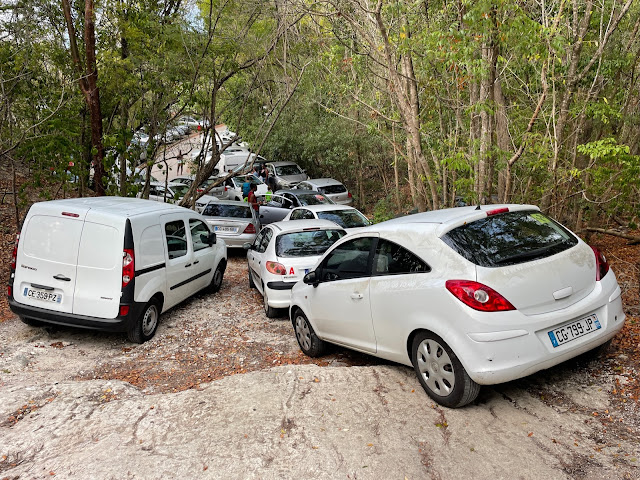 |
| Parking for campsites on holiday weekends could be a bit free form!!! |
Touring Martinique with Neil and Susie let to a quest for the search for the best rum distillery! Important research that must be done!
 |
| Some cool old machinery in these early distilleries |
Like most of the Caribbean islands, Martinique was formed by volcanoes. This was the site of the eruption of Mt. Pelee (cloud over Pelee shown above), in 1902. It sunk many ships anchored in the harbor, and covered the town in lava and ash, killing 29,000 people, one of the deadliest volcanic eruptions in history. Below is the floor of the large performing arts theatre in the city, now preserved as a national park.
Dominica:
After Martinique we sailed north to Dominica. We really didn't have high expectations....in fact we had few expectations at all. We really didn't know much about the island. We knew it had been hit hard by hurricane Maria in 2017. The entire island had been devastated, with whole villages being washed away. But the word was that it was recovering nicely, and we anchored in Portsmouth to have a look.
Wow, we were so glad that we did! Dominica proved to be our favorite island in the Caribbean (of the relatively few we've explored). The people couldn't have been nicer, and, with no international airport, there really is little large scale tourism except for the cruising yachts who enjoy the island's charms. Nice, and a good taste of the authentic Caribbean that we've been looking for!
One interesting program that's been developed in Portsmouth Bay (which should be copied throughout the Caribbean) is the recent formation of PAYS (Portsmouth Association of Yacht Services). In the past, when visiting yachts would enter the harbor, they would be swamped by hordes of "boat boys"; young guys who would offer, sometimes quite aggressively, their services for everything from help anchoring, cleaning, dinghy watching, etc. It got so bad that many boats simply took Dominica off their list of islands to visit. So a few years ago, a few yachties got together with the island leadership and shared the concerns. And out of the meetings developed the idea of the PAYS collective.
Now, each day is "owned" by one of the guys, in a regular rotation. When we entered the bay, a single boat came out to greet us, and offer us any assistance needed, including interfacing with Customs and Immigration. Sure there was a fee (around $40US, as I recall), but we felt like we were getting something in return, and it was good to pump some money into the economy (hurting badly after the double whammy of Maria followed by Covid). They own (and supposedly maintain) the moorings in the bay, which we tied to. And host a great bbq every Sunday night. All good stuff, and should make Dominica a must visit stop on all cruisers' itineraries!
We did a couple of island tours with Martin "Providence", one of the founders of PAYS, and an Ocean Cruising Club port officer. Martin trained as a botanist and was a wealth of information on all of the incredible plant species on the island, whether ornamental, edible, or medicinal. With the large rainforest on the island, the plants and bird species are really phenominal, and we really enjoyed all of the time Martin shared with us.
Sint Maarten:
Our stay in Dominica of just over a week was far too short, but time was running out as the June 1 official start of hurricane season was getting ever closer. Sadly we said our goodbyes, and headed out in the evening for the overnight sail to Sint Maarten. Known as a popular duty free port, we were hoping on some values in camera gear, diesel, electronics, etc. Unfortunately we found that those days are over. While there may not be duty on items, the prices are not much better than we'd find available from mail order shops or chandleries in the US and Europe. Ah well.....
 |
| Waiting for a cruise ship!!! |
 |
| For all of the "Breaking Bad" fans out there!!! |
We anchored in Simpson Bay on the Dutch side (1/2 of the island is owned by the Dutch, the other by the French). There are some excellent chandleries and yacht services available. But we didn't need too much done, so spent less than a week here before moving on.
British Virgin Islands:
And this brings us to the BVI's, where we are today.
The BVI's are cruising Disneyland! All charter boats, all the time!!! It's really pretty amazing, and in 12 years of cruising around the world, we've never seen anything like it! In most anchorages or mooring fields, we are the only non-charter boat around, and usually the only monohull in a sea of catamarans.
 |
| If you can time it right, the BVI's can be quiet and beautiful! |
 |
| Unfortunately this is more typical (and this was 1/2 empty according to the locals) |
But we certainly get it. The islands are very pretty, with lovely beaches and sheltered anchorages and bays. If it's your scene, the beach bars are anywhere you like, and the rum punch and painkillers flow freely. Navigation is line of sight between islands, and the inner Drake Channel provides swell free sailing from anchorage to anchorage. Perfect for a 2 week charter holiday. Snorkeling is fair, not great.
Nice, but not really our scene. We'll spend a few more days getting provisioned, then wait for a weather window to get north to Bermuda. From there we'll head to the US North East, where we'll work our way from NY to Maine, then up to Nova Scotia and Newfoundland for the summer.
Wrap Up:
Our season in the Caribbean has been interesting, though not spectacular especially after 10 years in the South Pacific. Much of it is crowded with snowbird sailors and charters, and it requires a lot of effort to get "off the beaten track". But as we said above, we get it. Boat services are fairly easy to come by. It's easy (though less so in these Covid times) to hop from island country to island country, and while there is a certain sameness to them, each has it's unique personality. Obviously we felt that in Dominica, where we very much hope to revisit one day. And there are several island groups which still await our exploration for the next trip south, such as the Grenadines. Ahhh, the saying "so many islands....so little time" was never truer. Cheers!